nel-chain: Electronic Cash with One Identity per Human
Version 0.1 · October 20, 2026 · Draft
Abstract. nel-chain is a learning blockchain that pairs a permissionless-style ledger with a rule Bitcoin does not have: each verified human holds at most one identity (a Soul ID). That rule lets the chain launch with zero coins, pay a one-time welcome grant per person instead of a pre-mine, choose block producers by secret lottery among people rather than by capital, and warn users about addresses others have reported as scams. The price is trust: attesters vouch for humanity, a court can open sealed records, and an issuer backs the digital peso. This paper describes the design, its numbers, and those trust assumptions. Version 0.1 — a draft; nothing here has monetary value.
1. Introduction
Bitcoin showed that strangers can agree on a ledger without a bank. It did not solve three problems that matter to ordinary users in the Philippines and elsewhere.
- Scams are final. A payment to a fraudster cannot be reversed, and nothing warns the sender that others were already robbed by the same address.
- Accounts are free to fake. One person can run a million wallets, so any rule "per person" (a grant, a vote, a report) is broken by bots.
- Supply favors insiders. Most chains start with a pre-mine or sale, and block rewards flow to whoever already holds the most capital or hardware.
nel-chain addresses all three with one primitive: a Soul ID, a non-transferable identity that at most one per human can hold. Section 3 explains how a Soul ID is issued without putting anyone's name on the chain. The rest of the design builds on it: welcome grants instead of a pre-mine (Section 5), a lottery among people instead of among coins (Section 4), and scam reports that count people rather than accounts (Section 7).
The goal stated by the project's author is digital money that no single party holds the supply of. The trade-off is explicit: nel-chain trusts identity attesters, a court and a peso issuer for narrow, auditable roles (Section 11).
nel-chain is an open learning project. The reference implementation is TypeScript, with over 220 automated tests, and runs three networks: lab (fast numbers for teaching), testnet (real time, no value) and mainnet (a draft that the software refuses to run).
2. Transactions
nel-chain uses accounts, not coins. Each account holds a NEL balance (1 NEL = 100 units), an nPHP balance in centavos, and a nonce that counts its transactions, so an old transaction cannot be replayed.
An address is nel + the first 40 hex characters of SHA-256(scheme + public key). Every transaction names its signature scheme, which makes the chain crypto-agile: an account can rotate to a stronger key without changing its address or moving funds.
| Scheme | Key and signature | Why it exists |
|---|---|---|
ed25519 | 32-byte key, 64-byte signature | Default; fast and widely audited |
ml-dsa-44 | 1,312-byte key, 2,420-byte signature | Post-quantum (NIST FIPS 204) |
passkey-p256 | WebAuthn assertion, P-256 | The phone's secure chip signs; requires user verification (fingerprint, face or PIN) |
The signed message is every field except the signature, prefixed with the chain ID (for example nel-testnet-1). A transaction signed for one network fails verification on any other, the same protection Ethereum adopted in EIP-155. Votes and block hashes include the chain ID too.
Fees follow the shape of EIP-1559. Each block has a base fee that rises or falls by at most 12.5% depending on how full the previous block was, and a sender may add a tip. A transaction states a maxFee it will not exceed. All fees join the block reward in one pot; part of the pot is burned and the rest is shared equally by the committee members who voted for the block (Section 5). Official acts of institutions (an attestation, a cash-in, a court order) pay no fee, because a fair launch gives institutions no coins to pay with.
Paying fees in pesos. A person without a PhilSys number gets no Soul ID and therefore no welcome NEL, so they would have no way to pay any fee. Such a sender may instead sign a maxFeePhp: the chain buys the NEL fee from the exchange pool with the sender's nPHP, and that NEL then joins the block's pot like any other fee, so the monetary policy is unchanged. The cap is part of the signature; if someone moves the pool price so that the fee would cost more, the transaction is rejected rather than overcharged. Anyone can therefore pay, while only a verified person receives free NEL and a lottery ticket.
Capacity. A block holds at most 4,000 transactions and 4 MB, so about 800 transactions per second at one block every 5 seconds. One CPU core checks about 3,900 Ed25519 transfers per second even with a million accounts (npm run capacity), so a full block costs about one second of checking; the byte limit keeps a block of large post-quantum transactions (about 7.7 KB each) under roughly 6.4 Mbit/s. Accounts live in a persistent map, so changing one account copies a few small nodes rather than the whole ledger.
Payment channels. Many everyday payments go to the same recipient: a jeepney fare, a neighborhood store. A payer can lock nPHP once in a channel to that recipient (channel-open) and then pay by handing over signed vouchers, each stating the running total, with no block, no fee and no wait. The recipient keeps only the latest voucher and claims it once (channel-claim), which pays the total and returns the rest to the payer. If the recipient never claims, the payer recovers the deposit after the channel expires (30 days in the mainnet draft). Opening a channel counts against the payer's daily limit like any payment. Thirty payments thus cost two transactions. In the reference wallet (NelPay, under "Suki"), each voucher travels as a QR code of under 200 characters; the store's app checks the signature against the confirmed channel at once and keeps only the largest voucher on the phone, so losing the phone loses the payments since the last claim. Channels run in one direction to one recipient; payments routed across several channels, as in Bitcoin's Lightning Network, are not implemented.
Consensus also bounds size: a transaction may not exceed 16 KB, enough for the largest legitimate case (an ML-DSA key signing an ML-DSA key rotation, about 10 KB).
3. Soul ID: one human, one identity
A Soul ID is created when two attesters of different kinds each sign a soul-attest transaction for the same address and the same person. No single attester, not even the government, can create a person alone.
| Attester (testnet role) | Kind | Also does |
|---|---|---|
| PhilSys | government | — |
| PSA (civil registry) | government | Reports deaths (Section 7) |
| SSS | government | — |
| Barangay | community | — |
| Bangko Nel (the nPHP issuer) | private | KYC tiers and cash-in (Section 6) |
The attester checks the person off-chain (an ID document, plus face or fingerprint with a liveness check) and publishes only four things:
- a person hash: HMAC-SHA256 of the normalized PhilSys number, keyed with a secret salt that only the attesters hold. A second Soul ID for the same number is rejected: "1 person = 1 Soul ID";
- a masked name such as
J*** D. C., enough for a recipient to recognize a friend, not enough to identify a stranger; - a sealed record: the full name and ID number encrypted so that no single party can read it (Section 8);
- what was checked: the type of ID, face or fingerprint, and that liveness was confirmed, never the biometric itself.
Any ID, one person. If uniqueness rested on whatever ID number a person shows, one person with a passport and a driver's license could hold two Soul IDs. So the first attestation must come from PhilSys, the national ID system, which already deduplicates its registrants by comparing biometrics against everyone enrolled; the second may rely on any valid ID (passport, driver's license, UMID, PRC, postal, voter's ID or a barangay certificate). Biometrics never reach the chain: an attestation carrying any field beyond the allowed ones is rejected. They remain with PhilSys and the attesters, under the Data Privacy Act of 2012, and a breach there would be outside the chain's control (Section 11). A country without a deduplicated national ID would need such a registry before it could join.
Each attestation also names a barangay. The chain compares the number of Soul IDs per barangay with the PSA census and flags any area with more Soul IDs than residents, which makes mass fake identities visible. A court can jail an attester caught creating fake people, but only through an opened case.
Community vouching. A Soul ID can also come from people instead of institutions, as in Proof of Humanity and BrightID: two different people who already hold a Soul ID each sign a soul-vouch for the same address, name and barangay. A voucher must have held a Soul ID for some time (30 days in the mainnet draft), may vouch for at most 3 people per period, and receives a strike whenever a court declares someone they vouched for fake; two strikes end their vouching for good. No ID number or biometric is recorded, so uniqueness rests on the vouchers alone. A voucher may first run an in-person liveness check on their own phone or computer camera: an on-device face model asks the person to blink and turn their head in a random order, and only "passed" or "not done" is recorded, never an image. The check runs on the voucher's device rather than the newcomer's, because a check run by the person being verified could simply be faked by them. This path is weaker than PhilSys deduplication against organized rings, but it lets a testnet or a small community grow without any bank or government.
When a fake gets through. A new Soul ID's welcome grant is locked for 30 days in the mainnet draft (1 hour on testnet). It can pay fees or be staked, but not sent, much as Bitcoin's newly mined coins wait 100 blocks, and the new Soul ID joins the validator lottery only after the lock ends. If a court declares the Soul ID fake through an opened case (soul-fake), its keys can no longer send anything. The remaining welcome (up to 10 NEL, from wallet or stake) is burned, and the Soul ID stops counting toward the validator reward. Coins it already paid to others stay with them: finality is never undone. Each attester that vouched for it gets a strike, and three strikes suspend the attester; one proven to have colluded is jailed at once. An attester may also vouch for at most 20,000 people per day, which caps the damage of a stolen attester key.
A Soul ID cannot be transferred. Its identity key can link up to five signing keys (a phone, a laptop), and each link carries the signing key's own consent signature, so no one can attach someone else's address to their identity. The second valid attestation mints the one-time welcome grant of 10 NEL to the new Soul ID.
4. Consensus: a secret lottery among people
There is no mining. Blocks are made by a committee drawn by lottery for each round, in the style of Algorand, with one twist: every Soul ID gets exactly one ticket, however much it stakes.
Candidates. An account becomes a candidate by staking at least 1 NEL while its Soul ID is active and it is not jailed. Two keys of the same person count once. While fewer than four Soul IDs stake, four bootstrap validators fill the gap; they hold 0 NEL, earn nothing, and leave automatically once four people are validating.
The draw. For each height and round the seed is prevHash | height | round. Every candidate privately computes a verifiable random function, ECVRF-EDWARDS25519-SHA512-TAI from RFC 9381, over the seed with its own Ed25519 key. The output is a ticket between 0 and 1; the candidate is in the committee if the ticket is below E ÷ (number of candidates), where E is the expected committee size: 7 on lab, 21 on testnet, 1,000 in the mainnet draft. Nobody, the candidate included, can choose a better ticket, and nobody else learns who was drawn until that member votes. The implementation matches the official RFC 9381 test vector.
Proposal and votes. Proposers are drawn secretly too. Each candidate computes a second VRF ticket over the seed and may propose if it falls below 5 ÷ (number of candidates), so about five people can propose in each round and nobody knows who in advance; the proof travels with the block. One second into the round, drawn members vote for the eligible proposal with the lowest ticket, signing (chain ID, height, round, block hash) and attaching their own VRF proof. A block is final when it has floor(2E/3) + 1 valid votes from drawn members. If a round produces nothing within the round timeout (3 s after the 3 s block interval), for example because votes split between proposals, the next round starts with a fresh draw.
Accountability. A member votes once per round. Two signed votes for different blocks at the same height and round are evidence anyone can submit; the offender loses 50% of its stake, which is burned, and is jailed. Unstaked coins return only after an unbonding period (21 days in the mainnet draft), so misbehavior can still be punished. Finality is immediate: a final block is never reorganized. Each block's time must be later than its parent's, and honest nodes ignore proposals more than 15 seconds ahead of their own clock. Releases also carry checkpoints, known hashes of final blocks, so a new node refuses any other history at those heights; this guards syncing nodes against long-range attacks by validators that have already unstaked.
The voting key starts as the stake's own Ed25519 key. An account that later rotates to ML-DSA or a passkey keeps voting with that Ed25519 key, while a new Ed25519 key installed by guardian recovery replaces it, so a thief cannot keep voting.
Separate consensus key. A validator does not need its wallet on the always-on computer that runs its node. The node creates its own key, and the wallet registers that key's public half with a validator-key transaction, much like the consensus key of a Cosmos validator or the signing key of an Ethereum validator. From the next block, votes and lottery tickets for that account are checked against the registered key. The key cannot move coins or the stake, so a stolen node key costs at most a slashing, and only until the owner registers a new one. A retired key still counts as evidence for double votes it signed while it was active, so changing keys does not escape punishment, but it cannot be used to frame the owner for later blocks, and evidence older than the unbonding period is refused. No two validators may share a key, present or past, and once a separate key is set, rotating the wallet key leaves it alone.
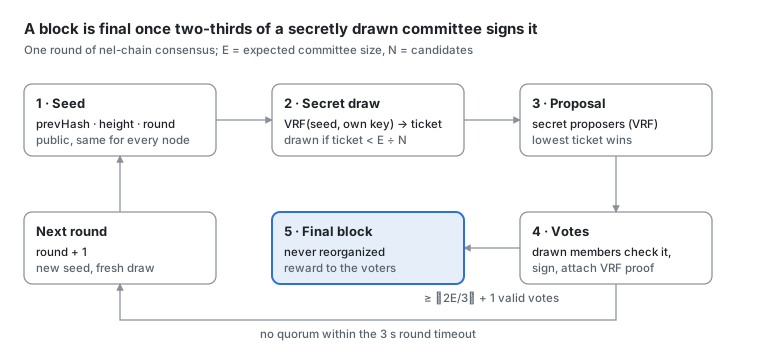
The draw stays secret until a member votes, so an attacker cannot know whom to bribe or attack before the block is already signed.
5. Monetary policy: a fair launch
The genesis block holds 0 NEL. There is no pre-mine, no sale and no treasury. NEL enters circulation through exactly two pockets, and every block records both along with what was burned, so anyone can check that supply = people + validators − burned.
- People: each new Soul ID receives a one-time welcome grant of 10 NEL. If 10 million people join, that is 100 million NEL. When a holder dies, the grant is burned back (Section 7).
- Validators: each block mints a reward shared by the committee members who voted for it and hold a Soul ID. Bootstrap validators earn nothing, and a block with no such voters mints nothing. The reward grows with the network: it equals the schedule below only once 10 million people hold a Soul ID, and is proportionally smaller before that (one million people earn a tenth of it). Without this, a small network would hand most new NEL to its first few validators.
| Mainnet draft, years | Block reward (≥ 10M people) | Maximum new NEL per year |
|---|---|---|
| 1–4 | 2 NEL | 12,614,400 |
| 5–8 | 1 NEL | 6,307,200 |
| 9 onward (tail, forever) | 0.5 NEL | 3,153,600 |
The year figures assume about 5 seconds per block, or 6,307,200 blocks per year; the halving interval is 25,228,800 blocks. Like Monero, nel-chain keeps a small tail emission instead of stopping at a cap, so validators are always paid even when fees are low.
Burn. Each block burns about supply ÷ 630,720,000, which is roughly 1% of supply per year, taken from the pot of fees and reward. The burn is capped at half of the pot (fees plus reward), so voters always keep at least half of both, however large the supply grows, much as EIP-1559 always leaves the tip to the validator. An earlier cap of fees plus half the reward let a large supply burn every fee: with 8.3 billion people in the model, income per validator fell to 158 NEL a year. With no fees, supply therefore still grows by at least half the reward per block; it can shrink only when fees are large. In the tail era the cap binds once supply passes 157,680,000 NEL. This is a slow, predictable inflation that declines as a percentage over time, not a fixed supply, and the paper does not claim otherwise.
No person, company or foundation holds a share of the supply at launch, which is the project's central monetary promise.
Locked rules. No one can quietly change these numbers after launch, including the project's developers. The welcome grant, the reward schedule, the halving interval, the burn divisor, the burn cap and the welcome lock together have a fingerprint (a SHA-256 hash) that is written into the software for testnet and mainnet. A node whose numbers differ from the fingerprint refuses to start, refuses a saved chain made under other rules, and does not sync from peers that report other rules. Changing the money therefore requires a new release with a new fingerprint, visible in the code, which takes effect only if node operators choose to run it: a hard fork, as in Bitcoin. The supply is not fixed; its rules are.
6. nPHP: a reserve-backed digital peso
NEL floats; most people want to pay in pesos. nPHP is a second asset on the same chain, counted in centavos, that only a licensed issuer can create and only against audited reserves.
- An independent auditor publishes the total pesos held in the issuer's bank account (
attest). - The issuer may mint nPHP only while total nPHP stays at or below that audited figure; a mint that would exceed it is rejected by every node, not by the issuer's goodwill.
- Cash-out burns nPHP back to the issuer, which pays out pesos off-chain.
The chain publishes the reserve ratio (audited reserves ÷ nPHP in circulation) so anyone can see when it drops below 100%. The issuer also records each account's KYC tier, and only the tier, never a name. An unverified account cannot cash in, and every tier has a balance cap; the reference values (₱1,000, ₱10,000 and ₱100,000) are placeholders, not a regulator's limits.
NEL and nPHP trade against each other in an on-chain constant-product pool (x × y = k, as in Uniswap V2) with a 0.3% fee kept by liquidity providers. Fees for nPHP transfers are still paid in NEL.
nPHP is only as good as the issuer and auditor. On-chain rules prevent minting beyond what was attested; they cannot prove that the attested pesos exist. Section 11 returns to this.
7. Protecting ordinary users
A chain for everyday payments has to assume users will be tricked, will lose phones and will die. These protections are consensus rules, not app features, so every wallet gets them.
| Risk | Protection | Mainnet draft value |
|---|---|---|
| Paying a scammer | Before sending, the wallet shows whether the recipient has a Soul ID, its masked name, whether this is a first payment to it, and how many people reported it. A Soul ID may report an address once; reports roll up across all addresses of the reported person. | Warning at 3 reports |
| Paying a brand-new account | The wallet also warns when the recipient has sent fewer than 3 transactions or its welcome grant is still locked, since a fake identity has no history yet. | Welcome locked 30 days |
| Stolen phone draining an account | Optional daily limit on nPHP outflow; large payments wait in an undo window the owner can cancel; trusted recipients skip both. | Undo window 120 blocks (~10 min) |
| Thief removing the limits | New safety settings take effect only after a delay. | 1 day |
| Lost or stolen keys | Guardians chosen in advance approve a new key for the same address; a majority is needed (2 of 3, 3 of 5). With every guardian's approval the new key works at once and the old one stops; with only a majority it takes effect after a delay in which the current owner can cancel, in case the guardians colluded. In the reference wallet, someone who lost everything creates a new key for the old address and sends a recovery link to their guardians, who approve it from their own wallets; the wallet accepts only guardians with Soul IDs. | Majority of guardians; delay 1 day |
| Phishing a password | Passkeys: the phone's secure chip signs each transaction after fingerprint, face or PIN; the chain rejects assertions without user verification. | Re-prompt above ₱1,000 in the reference wallet |
| Death | PSA reports the death; all keys freeze for a grace period in which the owner can answer "I am alive". Then the 10 NEL welcome grant is burned and NEL, stake, unbonding coins and nPHP pass to a beneficiary named in advance, or to an estate a court releases to the heirs. | Grace period 30 days |
| Unreported death or disappearance | A Soul ID with no activity (no transaction from any of its keys and no vote by its validator node; receiving money does not count) becomes dormant and stops counting toward the validator reward, while its money is untouched. After a longer silence it is treated as dead and goes through the same grace period. Two people with Soul IDs may also report a death (grace starts at once) or a disappearance in danger, such as a lost boat (grace starts only if no activity follows for years). Any activity, or "I am alive", undoes all of it; a cancelled death report gives each reporter a strike. | Dormant 2 years; missing 10 years; danger 4 years (Civil Code Art. 390–391) |
| No beneficiary and no claim | The estate waits for a court. If no one claims it, its NEL is burned, since no treasury exists to receive it; its nPHP is kept, because burning it would leave the peso reserve with the issuer (in law, unclaimed balances go to the state). | 10 years |
Scam reports are a signal, not a verdict: they warn the payer and do not block payments. Freezing an account requires a court case (Section 8).
8. Privacy and lawful disclosure
The ledger shows that an address belongs to some verified human, a masked name and a barangay. It never shows a name or ID number in the clear. Yet a victim of fraud should be able to reach the person behind an address through a court. nel-chain makes that possible only with a court order and a second, independent party.
Sealing. At attestation the full record (name and ID number) is encrypted with AES-GCM under a fresh 256-bit key K. K is split into three random pieces with K = X ⊕ Y ⊕ Z, and each trustee receives two pieces, each pair encrypted to that trustee's public key (X25519 key agreement derived from its Ed25519 key):
| Trustee | Holds | Can read alone? |
|---|---|---|
| Court | X, Y | No |
| Issuer | Y, Z | No |
| Auditor | X, Z | No |
Opening. The court opens a case on-chain, citing a court order number. The issuer or the auditor then approves by re-encrypting its pieces to the court's key only and publishing them. With its own pieces plus one approval, the court holds X, Y and Z and decrypts the record; nobody else can, because the released pieces are readable only by the court. Every step is a public transaction, so each disclosure leaves a permanent, auditable trail.
Freezing. Once a case is open (two of three trustees), the court can freeze and later unfreeze the suspect's accounts. Without an open case, the court cannot freeze anything.
This is a scheme for 2 of 3 in which the court is always one of the two. A general threshold scheme (Shamir's secret sharing) would allow other policies, such as 3 of 5.
9. Network
Nodes speak JSON over WebSocket. Each node keeps the full chain, re-checks every block it receives (signatures, Merkle root, base fee, sortition and votes) and trusts no peer.
Between nodes, every connection starts with a handshake modeled on CometBFT's SecretConnection: the two nodes exchange ephemeral X25519 keys, derive one ChaCha20-Poly1305 key per direction, and each signs the handshake with its Ed25519 node key. Traffic cannot be read, altered or replayed, and each side knows which node it is talking to. Nodes also announce where they can be reached and share addresses with each other, so a new node needs only one seed to find the rest. Browsers and tools connect as plain clients: they may submit transactions and ask questions, but votes, proposals and blocks are accepted only from authenticated nodes.
- A new transaction is checked against the node's view of the ledger plus pending transactions, kept in a bounded mempool, and gossiped to peers. The sender gets an immediate accept or reject with the reason.
- Every second a node announces its chain height, chain ID and last hash. A node that is behind requests blocks in batches of at most 100 and verifies each one before accepting it.
- Proposals and votes are re-broadcast each second until the block is final, so a node that reconnects catches up on the current round.
The chain starts from a genesis file listing the public keys of the bootstrap validators and institutions; their secret keys never leave their owners' machines. A node refuses to start with a key that does not match the genesis file, and a client refuses a node whose chain ID differs from its own.
Defenses against abusive peers, modeled on Bitcoin Core:
| Limit | Lab | Testnet |
|---|---|---|
| Largest message | 1 MB | 16 MB |
| Message rate per connection | burst 300, then 100 per second | same |
| Inbound connections | 64 | 64 |
| Ban after 100 misbehavior points | 1 minute | 24 hours |
Inbound connections are also limited to 8 per IP address and 16 per network group (/16 for IPv4); when every slot is full, the newest connection from the most crowded group is evicted, while the longest-connected and most recently useful peers are protected. Outbound connections go to different network groups, and the two longest-lived ones are remembered as anchors for the next restart. Local and private addresses are exempt so that labs and home networks keep working.
Every inbound message is shape-checked before it is processed. Malformed messages, fake signatures on transactions or votes, invalid blocks during sync and floods all add misbehavior points; at 100 the connection is cut and the IP address banned. Commands meant for the teaching lab, such as pausing a node remotely, are refused on other networks.
10. Calculations
The question Satoshi asked of proof-of-work has a counterpart here: if an attacker controls a share s of the Soul IDs that stake, how likely is it that one committee of expected size E contains enough attacker members to finalize a block on its own? With such a committee the attacker could finalize two conflicting blocks or censor transactions; it still could not finalize an invalid transaction, because every node re-validates every block.
Treating the committee as E independent draws, the probability is the binomial tail:
P(E, s) = \sum_{k = \lfloor 2E/3 \rfloor + 1}^{E} \binom{E}{k} s^k (1 - s)^{E - k}
| Expected committee E | Votes needed | s = 10% | s = 20% | s = 30% | s = 33% |
|---|---|---|---|---|---|
| 7 (lab) | 5 | 1.8 × 10⁻⁴ | 4.7 × 10⁻³ | 2.9 × 10⁻² | 4.3 × 10⁻² |
| 21 (testnet) | 15 | 3.0 × 10⁻¹¹ | 5.1 × 10⁻⁷ | 1.1 × 10⁻⁴ | 3.6 × 10⁻⁴ |
| 100 | 67 | 9.6 × 10⁻⁴³ | 3.1 × 10⁻²⁴ | 2.7 × 10⁻¹⁴ | 3.9 × 10⁻¹² |
| 1,000 (mainnet draft) | 667 | below 10⁻³⁰⁰ | 2.2 × 10⁻²²⁴ | 3.3 × 10⁻¹²⁶ | 6.5 × 10⁻¹⁰⁵ |
Values are per round, computed by captureOdds in the reference code. At a block every 5 seconds a lab-sized committee with a 20% attacker would be captured several times a day, which is why the lab is only for teaching. At E = 1,000 the risk is negligible even for an attacker holding a third of all staking people.
The real defense therefore moves from mathematics to identity: an attacker must recruit, bribe or fake a large share of all verified humans who stake. The census check (Section 3), two-kind attestation and attester jailing exist to make that expensive and visible.
11. Trust assumptions and known limitations
Bitcoin asks users to trust only that most hash power is honest. nel-chain asks for more, in exchange for one-person-one-identity, scam warnings and a peso. Each trusted party has a narrow role, and every action it takes is a public transaction.
| Party | Trusted to | Cannot, by consensus rules | If it fails or colludes |
|---|---|---|---|
| Attesters (PhilSys, PSA, SSS, Barangay, bank) | Check that a real, unique person stands behind each Soul ID | Create a Soul ID alone (two kinds are needed) | Two colluding kinds can create fake people, weakening every per-person rule; the census check, the locked welcome grant, a daily cap per attester, strikes and court jailing make it slow, visible and punishable, not impossible |
| Issuer (Bangko Nel) | Hold one real peso per nPHP and pay out on cash-out | Mint beyond the audited reserves | nPHP loses its backing; NEL is unaffected |
| Auditor | Report reserves truthfully | Mint, or read records alone | With the issuer, can hide a shortfall |
| Court | Act only on lawful orders | Read a sealed record or freeze an account without a second trustee | With the issuer or auditor, can de-anonymize any Soul ID; every step is public |
| PSA (deaths) | Report deaths accurately | Move anyone's coins directly | A false report freezes keys for the grace period; the owner cancels it by answering "I am alive" |
| Bootstrap validators | Produce blocks until four people validate | Earn rewards | Can stall or fork the chain in its first days |
Known limitations of version 0.1.
- Identity data: the person hash is keyed with a secret salt held by the attesters, but any attester holding it can still test guesses of ID numbers. Masked names and barangays still reveal something, and, as in Bitcoin, the transaction graph is public. Uniqueness depends on PhilSys deduplication, and the biometrics behind it are held off-chain by PhilSys and the attesters, where a leak could never be undone.
- Consensus: votes are not aggregated: each carries its own signature and VRF proof (about 150 bytes), so a 1,000-member committee adds roughly 150 KB to every block. BLS aggregation would save the signatures but not the VRF proofs, and is not post-quantum. When votes split between secret proposers, the round is lost and a new one starts, which costs a few seconds. Consensus keys and the VRF use Ed25519, which is not post-quantum; only account keys can move to ML-DSA.
- Network: node-to-node connections are encrypted and authenticated, and peers are discovered automatically. Bitcoin Core-style limits per IP and per network group, eviction that protects long-lived and useful peers, and anchor connections raise the cost of an eclipse attack, but do not stop an attacker with addresses in many networks. Browser connections are plain WebSocket and need a TLS proxy on a public node.
- Economics: a 40-year model of the mainnet draft (the
/economicspage) first showed that a fixed block reward sends most new NEL to validators in a small network (98% in four years with 100,000 people and 100 validators). The reward now scales with the number of Soul IDs, which brings that share under 20% in the modeled cases. Even at 4,000 transactions per block, one payment a day by all 109 million Filipinos (2020 census) wants about 1.6 times the capacity; if half of those payments go through payment channels, demand falls to about 0.84 of capacity. With large fees the supply can shrink; with low fees it grows at the tail rate. When demand exceeds capacity, the model raises the fee as the base fee would, assuming that doubling the fee halves demand. The model simplifies adoption and fees, and says nothing about price. - Assurance: one implementation, in TypeScript, with over 330 automated tests and no external security audit. A threat model (
THREAT-MODEL.md, also at/threats) lists 44 known attacks with their defenses and residual risks; only 1 is still open: post-quantum consensus keys. Lab parameters exist precisely because the defaults are for teaching. - Law: operating a digital-asset service, issuing a peso stablecoin and processing identity data in the Philippines would require, at least, registration with the Bangko Sentral ng Pilipinas, review by the Securities and Exchange Commission, and compliance with the Data Privacy Act of 2012. None of that has been sought.
12. Status, roadmap and conclusion
Status (October 2026). Everything described above is implemented in the reference code, covered by automated tests, and runs on a four-node testnet whose validators and institutions use their own keys; one command opens it to friends from a home computer through a Cloudflare tunnel, and their nodes join by connecting out to it. The wallet (NelPay), a block explorer, an identity lookup and a browser lab that lets anyone try to cheat the chain are part of the same project, together with 67 lessons explaining each part.
Before any mainnet, in this order:
- A public testnet operated by several independent people.
- Smaller votes, so that committees of 1,000 are practical (aggregation or compact proofs).
- Post-quantum consensus keys.
- Routed payments across channels (a Lightning-style network) if one-to-one channels prove too narrow.
- An external security audit of the code and of this paper, starting from the threat model's checklist.
- Legal review with the BSP, the SEC and the National Privacy Commission, and real agreements with any institution that would act as attester, issuer, auditor or court.
Conclusion. nel-chain explores a ledger in which the unit of participation is a person rather than a coin or a machine. Tying each account to at most one verified human lets the chain start with no insiders' supply, pay its validators by lottery among people, and warn payers about reported scams, while sealed records keep identities private unless a court and a second trustee agree. That design trusts identity attesters, a peso issuer and courts, in narrow roles that are visible on-chain. Whether that trade is worth making is a question for its users; this paper's aim is to state it plainly enough that they can judge.
References
- S. Nakamoto, Bitcoin: A Peer-to-Peer Electronic Cash System, 2008.
- Y. Gilad, R. Hemo, S. Micali, G. Vlachos, N. Zeldovich, Algorand: Scaling Byzantine Agreements for Cryptocurrencies, SOSP 2017.
- S. Goldberg et al., RFC 9381: Verifiable Random Functions (VRFs), IETF, 2023.
- NIST, FIPS 204: Module-Lattice-Based Digital Signature Standard (ML-DSA), 2024.
- W3C, Web Authentication Level 3.
- V. Buterin et al., EIP-1559: Fee market change for ETH 1.0 chain.
- V. Buterin, EIP-155: Simple replay attack protection.
- H. Adams, N. Zinsmeister, D. Robinson, Uniswap v2 Core, 2020.
- Monero, Moneropedia: Tail emission.
- A. Shamir, How to Share a Secret, Communications of the ACM, 1979.
- Bitcoin Developer Guide, P2P Network.
- Republic of the Philippines, Republic Act No. 10173: Data Privacy Act of 2012.